
This is from a Trial at Hornsby Girls’ HS.
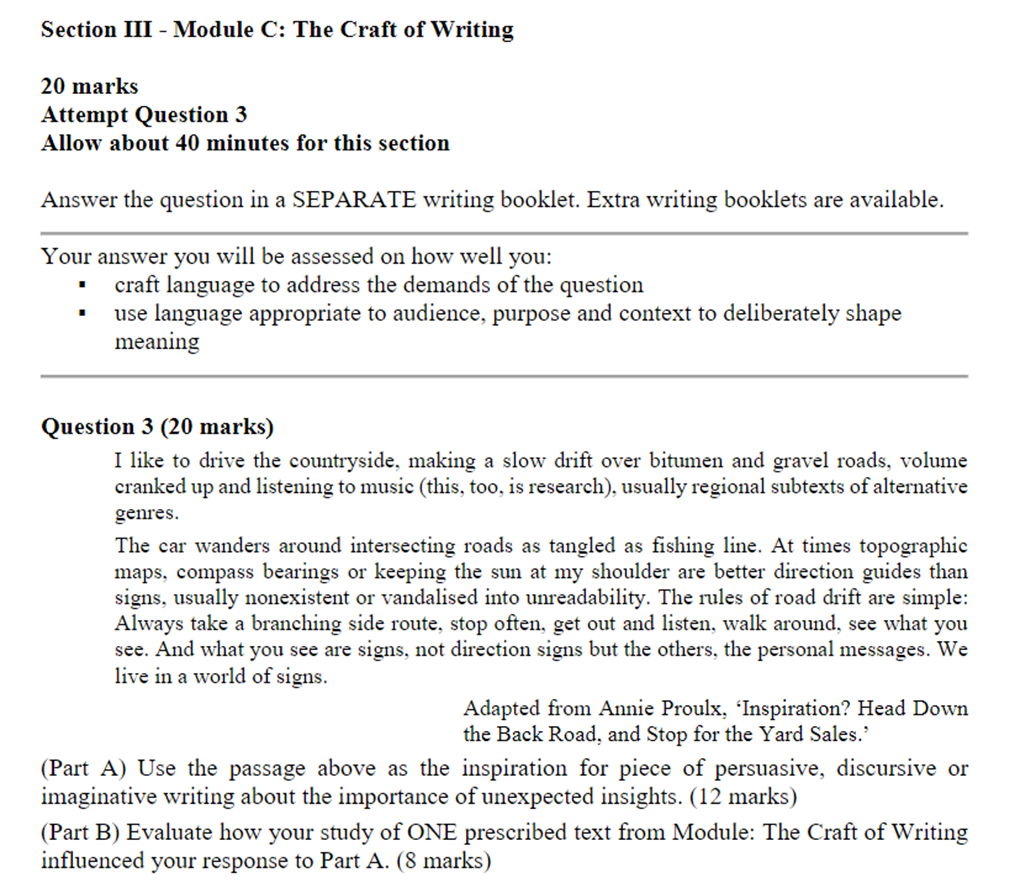
Sometimes, when I’ve been driving down the motorway, I’ve looked up at a tatty banner hanging from some overpass. You know the ones I mean: cheap art-class white poly-cotton, frayed at the edges and graying with exhaust fumes. The writing in capitals done with a wide, thinning nylon paintbrush.
It’s always about some girl: SHELLEY I LOVE YOU or DAISY MARRY ME. Once or twice it’s been the horrifying OLIVIA BAKER IS A … well, you can imagine.
I read it, vaguely wonder who Shelley and Daisy and the scandalous Olivia are, and pass by at 70 mph.
It’s the same with sky-writing: hanging out your washing, you wonder who these people are and have forgotten them before their names turn back to vapour trails, to cirrus in the afternoon sky.
I was frequently jealous of these girls, the objects of so much passionate signage. Even the Olivia Bakers, who have clearly caused outrange and indignation. I’m jealous of the boys’ unabashedness, and the fact that the girls – probably 16, drama-prone, and given to equally impassioned actions – know how to respond to these grand gestures.
These signs are part of the greater language of popular romance – end-of-movie climaxes, kisses in the rain, now—or-never choices, entirely new life-paths decided upon in a moment of consultation with the heart. It’s a nonsense language, like the languages you make up as a child; they generally ‘hum’ like a real language, but when you look closely at them you see that the signs refer to nothing recognizable in the world.
(To be an absolute snob about it, I could also add that it is a class-based language too: like fake diamonds, gel nails, high heels you can’t walk in, and too-tight dresses, motorway-signage for romance is shunned by the aspirational middle classes who secretly envy the pants off those who bask in it. We’re still stuck in the nineteenth-century prison of private feelings, tasteful declarations, and nonsense ideas of meritocracy. If you deserve to be special, you will be, we think, because merit always wins.)
As I said, usually I see the signs, tighten my grip on the steering wheel and zoom on to wherever I’m going. I leave my little twinge of jealousy behind as unproductive.
This is the subject of an unexpected insight: the fact that I’m always going somewhere. I’m always trying to be productive. I can’t just drive up and down the motorway, or around the winding ways, looking at these odd things that people leave around the place as traces of themselves. I can’t let myself get side-tracked by things that seem like trivia, minutiae.
I have tried. I’ve tried going for a drive. To where? Nowhere. Just…out. Out and about. I used to get in the car when I was a graduate student at Oxford and head out around the lanes and B-roads of the county. I tried very hard to be random, to have no fixed direction. It was impossible. I found myself going to the same, safely known places, or following signs to something I could fit into a map of knowledge.
In a small sense, I’ve never been able to drift. Which is why I totally lack direction about the big things. I’ve found that people who can relax and let go about the little things are often those who achieve much in the big things. I cannot relax. Everything I do is for the purpose of ‘achieving’ something, going to somewhere.
Not necessarily a bad thing, until you question why. Why are you like this: a 30-year old woman, doing a second PhD, now sitting in a Honda Civic in an Oxfordshire lane, crying noisily as the blackbirds sing from the hedgerows and the whole evening is golden?
All alone and at your wits’ end you admit it to yourself: you can’t drift because you’re all about becoming more, greater, higher. Not in any real sense but in the eyes of other people. You will only be able to relax in a world without people, without the signs of others’ specialness, which drive you mad with envy.
You do everything to become the One all signs refer to.
Actually, I didn’t experience this unexpected insight in a country lane, but in a psychiatric unit in Sydney, when I had come back to Australia after entirely failing to fit in at Oxford. I got the doctorate, but was made miserable by the fact that everyone in Oxford wants to The One.
Back in Sydney, I couldn’t let my sense of failure go. I had a funny turn at Redfern train station, which is symbolic (Redfern is the station before the city proper begins. When I was at a very Catholic girls’ school in Sydney, withdrawal before ejaculation was called ‘Getting off at Redfern’). A nice doctor – who managed to be a good psychiatrist and the lead guitarist in a band called the Telemetry Orchestra – pointed out that I was burned out.
I wanted to say that the signs of burnout had been there for years. But the thing about signs is that they’re only useful if someone’s there to read them. And each person isn’t simply the referent of a sign, but an entire language in themselves. Socialisation gives us all mutually intelligible phrases, but in a large measure each of us is a language isolate. Part of love is bothering to learn the language of another person – and very few people (if any) ever become fluent in You.
Like Chilean Spanish, I tend to have two speeds: all stop or all go. I can’t just drift for an hour. And I had crashed at a fairly high speed after seven years in England. It took four years after leaving Oxford to rebuild my concentration span back to twenty minutes.
It still shows in my life more widely. I’m still hyper-focused on the small stuff and totally aimless about the big stuff. I’m driven, but not ambitious.
In my defence, I’d say that the kind of randomness, the drift, the ‘just being present’ state of mind that the Mindfulness crowd urges on you isn’t really one that has served our species well. It might make us happier, but most adults know that the relationship between survival and happiness is specious at best.
Humans are always looking for something, going to somewhere, building up something. Most of these activities are sign-making in some way. They refer back to us, to the Wonder of Me. When we drive the length of the country for a surprise birthday, or write a book, or buy a house, we’re really sign-making: I MADE THIS. AM I NOT GREAT? And then we get all offended when nobody bothers to read it. Because they’re all too busy going somewhere themselves, leaving behind signs about the Wonder of Them.
I think that to avoid feeling misunderstood or ignored you have to be content with learning the language of yourself, with drifting about the country lanes of your own thoughts and possibilities, with being sufficient. That is the unadmitted goal of all who drift; the hope that they will eventually find the sign that points to the road home.
 The Craft of Writing
Leave a comment