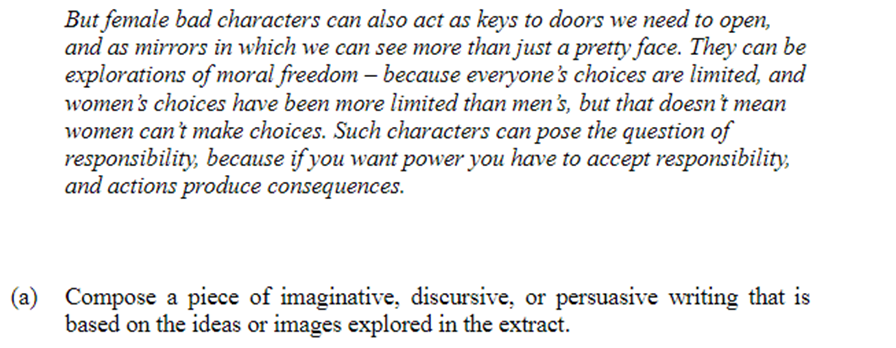
For more fun in the sun this week, I’ve used Cheltenham Girls’ Trial paper – they evidently did Margaret Atwood’s ‘Spotty-Handed Villainesses’ essay. Here was the task:
There was no way it would ever be written off as an accident. Switching the cribs could be accidental. Switching the babies in the cribs could be accidental (just). Switching the hospital wrist bands on the babies in the cribs could not be accidental. Nor, with constant and overlapping video coverage of the entire neonatal unit, could it ever be blamed on anyone else. If it was ever detected, she would go to prison for – well, she didn’t know. Years, possibly.
If it was detected.
But that was the whole point; to have the power, you had to wear the consequences, and this was something she had done her whole life. She was, she thought, the consequences of some couple’s arbitrary but infinitely powerful act. Everyone was, more than one psychologist had pointed out, and each time she had turned her plain, unhealthy face, stringy lank hair, and cloudy, unhappy eyes on them. She had stood up and made them look at her body – little, spindly as an underdeveloped child. A stature just short enough to show dandruff on the crown of her head, and terminating in an uneven gait from a left foot that had ‘gone wrong’ at her birth. She wasn’t crippled, and so got no privileges for it, but she walked with a lurching triple-time, compared to everyone else’s smooth 4/4.
She had been a corner-occupier through school, unable to wash out that smell of poverty of the spirit: disinfectant, stale fag smoke, rubbish, old biscuits, human sloth. By graduation she had learned to look at life as a series of nevers. Never had a friend. Never gone to a party. Never worn make-up outside. Never been complimented, never kissed. Never made anyone laugh – or cry. After her mother left, she was never told that she was loved. Her father came home from driving a cab all day, at dinner, watched TV, and went to bed. Never wished her ill, but never wished her good night either. Never even been bullied. The only reaction she got when she hoved into the bully’s view was a mild surprise at her existence and confusion about what year she was in.
She couldn’t say why she went into nursing. Perhaps she subscribed to the idea that the hand that rocks the cradle rules the world. Not a mother’s hand – that condition was denied her by virtue of practically everything – but the hand that rocked the humidicrib was a close second. And it made her laugh, sometimes, the thought that under her teddy-bear and clown printed scrubs, she was the evil fairy who had turned up uninvited to the christening and dealt out curses under the horrified eyes of the guests.
‘What’s wrong with her?’
She had been approaching the nurses’ station when she slowed and stopped. Her name had not been spoken, but she knew, from the twinge of irritation and distaste in the speaker’s voice, that the question was about herself.
A whisper of scrubs suggested that a second person had just shrugged, and another voice said, ‘Just born unfortunate, I suppose.’
She moved into view of her two colleagues, who stopped talking immediately. But they didn’t blush.
So there it was, the twin elements which had served her so poorly, and which she was not going to wield in some other baby’s favour: birth and fortune.
She had decided, though, not to do it on a whim. There were plenty of annoying new mothers flaunting wealth and happiness and good looks, and plenty of poor, ugly, regretful ones too, but none whose children cried out to her to rectify the balance of their outrageous fortunes.
Finally, the right pair of mothers appeared. Ding Ding, she thought. In the blue corner was Sophie Edgar, wheeled up from the Birth Suite in a cloud of flowers, clutching baby Annabel as if she was the Holy Grail. Maternity clothes by Boden, husband by minor public school and KPMG. Sophie had said to one of the other nurses that she didn’t like ‘the other nurse, the quiet one, the unhealthy-looking one’ touching baby Annabel and wondered if someone else could attend to them both.
And in the red corner was Jasmine McKibben, unwilling mother of Holly and possessor of two days’ worth of baby things in a plastic bag from Priceline. No maternity clothes, no partner, no fitness-nutrition-and-breastfeeding plan. No cab fare back to the council estate either. Baby McKibben had already experienced a gestation flavoured by cheap alcohol, fags, and light hallucinogens.
With her better bloodline and healthier gestation, baby Edgar would be fit to take on the rigours of a dismal home environment, cut-price schooling, and low-to-no expectations. Meanwhile baby McKibben’s fortune would be improved considerably, and even if she ended up as unattractive as her mother and the anonymous nurse who had been her fairy godmother, she would have a better accent, nicer dentistry, and the love of a mummy and daddy.
She hovered around the nursery door for a while, looking through the large window at the babies, lying in rows like playing cards dealt out for a hand of Solitaire. It wasn’t that she had nothing to lose – employment and relative freedom was better than a life behind bars. It was more that she would gain something invaluable, whichever way the future went. If the switch was never discovered, she would still have the knowledge that she, the overlooked, the unfortunate, the background static of society, had decisively changed a life. And if it was ever discovered, she would take the opportunity to explain why she had done it. It was all possible, if you accepted that you would bear the cost of your act.
She went into the nursery.
 The Craft of Writing
Leave a comment