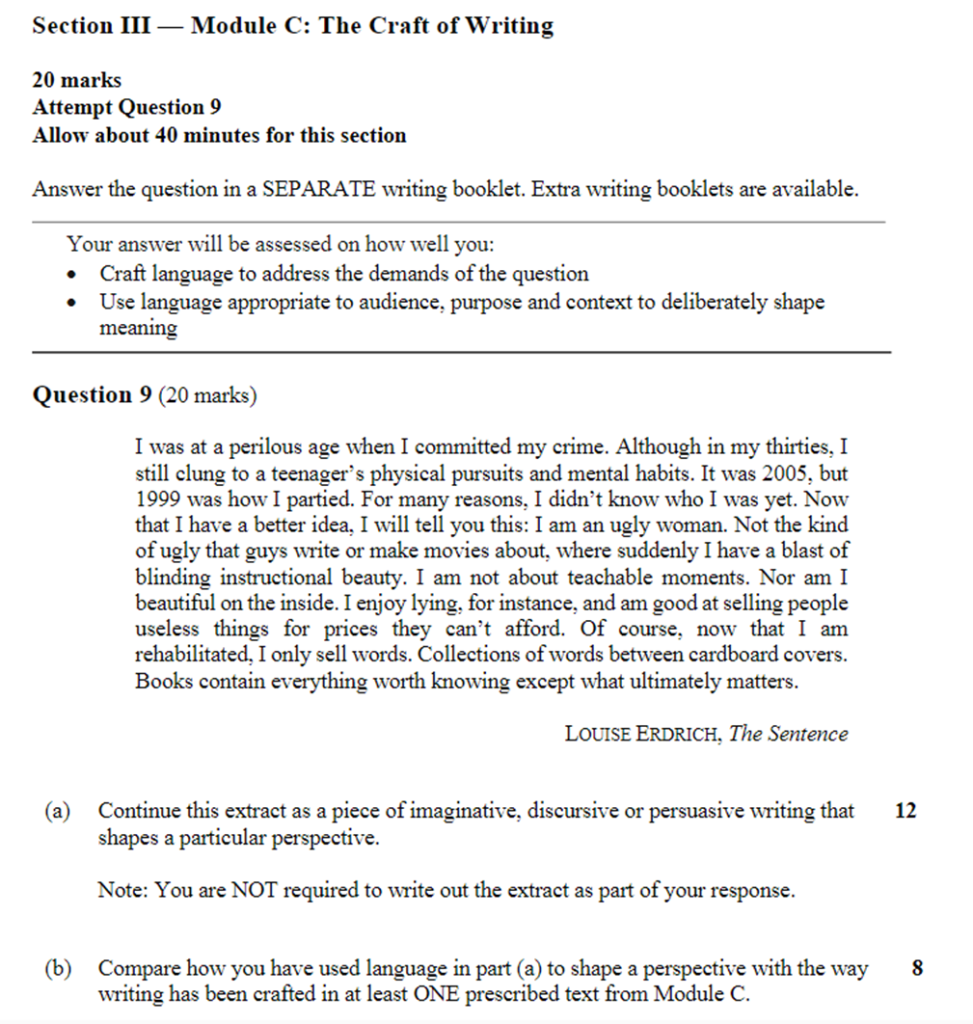
This is from Ascham school’s 2022 (?) Trial paper
Books contain everything worth knowing except what ultimately matters. The sort of books I write, anyway. The sort that sell. After trying and failing to sell stories about what does matter, I gave up. It’s enough to know the truth; you don’t have to share it. Look at the people who’ve tried to force the truth onto a disinterested public – it’s a non-starter financially, and sometimes it’s life-ending.
Put another way, here’s my writing axiom: people will not pay for stories about things that matter, but they will pay for them to go way.
It’s why people who are lonely, unhealthy, and unhappy buy bigger and bigger televisions, stare harder and harder at their phones, and read (if they read at all) longer and more escapist books. Look at Game of Thrones. Fifty Shades of Nobody’s Like That. The Dreadful Potterdom.
There are a lot of things books can’t give you. Human touch. Conversation. Books tell, but they don’t listen. Even the most intimate books are talking past you. Books end, and the world comes roaring back, cold and grey and difficult.
There are, though, also many things that books can give you – and if you’ve read this far, I expect you know what they are. They are not, however, the books that generally do well, by which I mean make enough money to put a thick pad of safety and silence between you and the world.
I realized this when I was sitting in a cafe one day, watching a woman choose a book. (It was one of those bookshop-cafes, which in themselves are evidence that literature no longer sustains life). She was a completely ordinary woman: semi-professional; the ‘wrong side’ of fifty with the age-appropriate feathery suddenly-blonde short bob, and the soft, solid pudge that says several children and a sedentary job. Wedding ring and a modest engagement ring and suburban mall bohemian-casual clothes – chino slacks and a gypsy top made in India for fifty cents and sold in air-conditioned comfort for fifty dollars. Statement necklace. She was probably called Carolyn or Angela and had pictures of her children in a bulging, ancient wallet. You know her: we’ve all worked for one, or with one, or even tried hard not to become one even as we sit beside them with our daughters getting ‘self-care’ manicures on a Saturday afternoon.
She was part of the noise that is pulled tight around us and rocks us from private birth suite to assisted living retirement home, and regards pain with terror.
She had a mug of overpriced froth, like mine, and a small stack of books on the table. There was one about gluten-free living, which seemed like an oxymoron. Something about living lightly and kindly, for forty dollars. Something else about hormones and menopause. A box-set of The Wheel of Time, with hermeneutical-looking symbols on the box and a cover showing the televised version. She spent half an hour flicking through them all and eventually took the novel. I nearly laughed.
I never said I was nice. Living in a world in which the trivial, superficial, self-indulgent and hypocritical thrive makes me worse.
However, I have read Umberto Eco. I know about taking pleasure in the defects of vulgar persons. What this means is that the market for fantasies, for more and more grotesquely distorted fairytales and outright lies about the eight-billion souls frantically sucking from the chrome teat of commerce, is now so large that it’s your own fault if you can’t make a profit from it.
So I write about things that don’t matter. The fantasies of renewal and escape that allow Carolyn from Human Resources to drag herself into her office for another day and keep feeding the Machine that’s killing her. Lies about the latent creative possibilities that she can dust off in her long, frightened retirement. The dark black part of me laughs a lot while I write. It’s like feeding sugar to a diabetic.
I have a recurrent fantasy in which the sunny suburbs are silent: they’re all dreaming themselves to death in their new-build homes with the three-car garages and IVF kids in the deluxe bedrooms, the hypoallergenic dogs in the low-maintenance garden. And when they’re all gone, off to some opiate-tinged wonderland, I’ll write about what really matters, even if there’s only me left to read it.
 The Craft of Writing
Leave a comment