
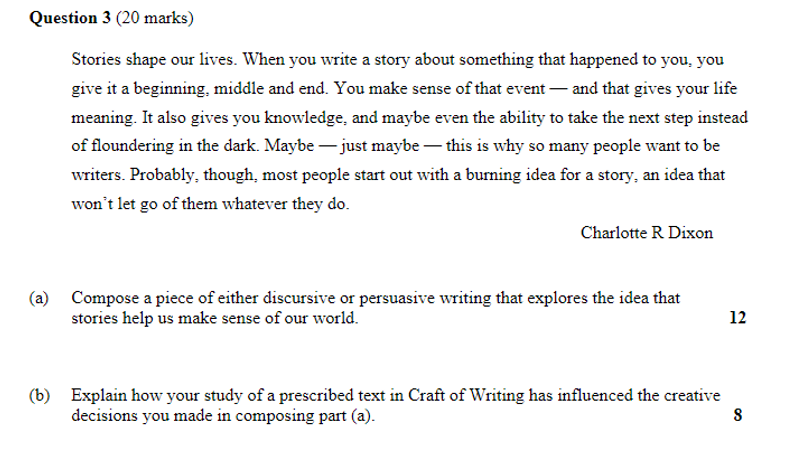
This is from Barker College’s 2022 (?) Trial paper. Personally, I think this would have been more fun as an imaginative, but I followed the question (part a anyway) as set.
It’s become a cliche to say that stories help us make sense of our world. It might have been new in the 1980s, but then mass-marketing locked on to the idea that you could sell stuff with story-advertising. Some of the story ads were great (the entire UK was invested in the Nescafe couple’s romance, which deftly got around the rank awfulness of the product). In the 2000s product placement was a heavier-handed version of the same, where an entire move was co-opted to flog something: James Bond, sitting in a boat in the Venice lagoon, bangs out an email to M on his Sony Vaio. The ease with which stories were contorted around filthy lucre spoiled stories, a bit.
Recursively, we’re sold the idea of how great stories are by being told that stories help us make sense of our lives – in other words, that one story helps us to make sense of another. It’s not untrue, but but it’s been used to justify an awful lot. I mean, I’m not sure how our basic habit of making narratives (that is, events in a sequence informed by the participants’ motivation, as EM Forster famously said) justifies a thousand hours of ferreting through sub-par poems for catalepsis or anacoluthon.
I think the idea is that stories provide vicarious experiences which save us from finding everything out the hard way. People with a big enough repertoire of stories make better guesses at how to handle situations. People (like me) with a huge repertoire of stories overthink those guesses and end up with two PhDs and a dodgy c.v. But anyway.
Certainly, knowledge of many stories provides a variety of answers to certain questions. When a child looks at a rainbow, for example, and asks ‘in what way does this happen?’ you can bore them rigid with factoids about atmospheric refraction, or you can tell them a star-spangled lie about the Rainbow goddess Iris, who travels the multicolour bridge from heaven bearing messages from the gods. Let’s face it, a kid who articulates questions like that is probably going to vanish into a chemistry set and stop talking to you anyway.
Stories also provide more interesting answers to questions about people: when we’re met by a neighbour’s hostility, stories provoke us to ask ‘who is this person really, and what’s important to them?’ And depending on the stories you like, you could see them as a Guardian of the Underworld, defending the liminal spaces in which the souls of the damned are held. Or it could just be Mr Bailey, who wants you to GTF off his lawn,
A healthy repertoire of stories provides us with alternatives to the boring, mystifying, and occasionally terrifying nature of real life. We can make sense of the world – which really means that we can cut it down to a manageable size – by asking ‘what if’ and supplying details from stories we’ve consumed.
OK, it’s probably clear that I’m not taking the stimulus seriously. That’s partly because I’m skeptical of where those gladsome aphorisms end up: in a hot dull classroom, vivisecting a squirming text with kids who just want to drop English.
More seriously, I have doubts about the logic of the claim. There are three parts to the statement: stories, us, and the world. One problem is that ‘the world’ (as far as we can know it) actually is us-plus-stories. It’s a construct, mediated by our sensory perception and consciousness of self. Except for a very few differently-wired folk, the shape of that construct is an inherently narrative one. What this really means is that, when we look out of our eye-portals, we’re always constructing a story called This Is What’s Happening. It’s not always a great story, but the main character is always us and the plot-problem is always ‘How do I satisfy the Wondrous Me?’
Sometimes there are prequels and sequels like ‘Hey You: Am I Not Wondrous?’ and ‘Wondrous Me II: How Do I Become Wondrouser’.
To all intents and purposes, we’ll never deal with ‘the world’ as it really is.
But when the Main Character (us) participates in a sequence of events, with some kind of motivation and has to deal with other people’s (usually foolish and incorrect) belief that they are the M.C. or have more legit. motivation, then Wondrous Me swings into action to set them straight. Drama ensues.
What’s interesting is that the more stories we know, the more our construction of ‘the world’ in which Wondrous Me acts out the ongoing saga of What’s Happening conforms to them. It’s rather like teaching an A.I. (what the A.I. would make of this, doesn’t bear scrutiny). It has an interestingly transformative power: like taking your kid brother to Spiderman – for the next two weeks everything reminds you that With Great Power Comes Great Responsibility. And then he starts shooting webs. Before you know it, he’s 35 and going to his stockbroker job as Spidey.
We’re already in a story, and the stories we consume add dimension and levels to that story. Before you know it, you’re living in a legend of your own making.
Mind. Blown.
 The Craft of Writing
Leave a comment